

Eco Factor: Tunnel Algae Park consumes CO2 from vehicular tunnels to produce biofuel.
Algae are one of the most robust classifications of life on earth. They grow in every continent and can thrive in any physical environment where they are able to derive energy from photosynthesis and the uptake of organic carbon.

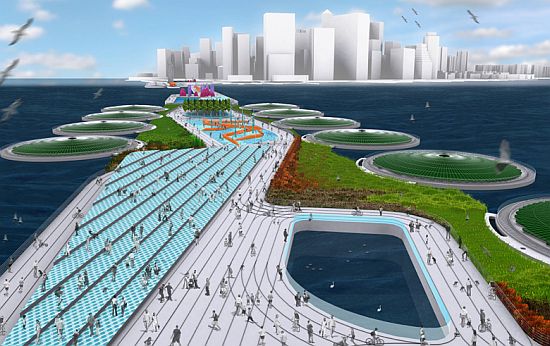
Atmospheric CO2 concentrations are high, but not high enough for industrial scale production of algae. However, in vehicular tunnels CO2 concentration is high, which makes it possible to harvest it and use it to feed algae. Port Architects is trying to use the ability of algae to produce oxygen when exposed to CO2, by building the Carbon T.A.P – Tunnel Algae Park in Chicago.

The new infrastructure manifests itself as a series of pier-like armatures that are linked to the ventilation system for the Brooklyn-Battery tunnel. The facility provides a 2-way system for capturing CO2 and providing it in a controlled manner to industrial-scale algae bioreactors. In this system, CO2 emission are captured and held in giant bladders, which are configured to deliver CO2 to a series of 20,000sf bio-reactors, which can also be detached for harvesting and processing the algae crop.

As the algae grow, CO2 is consumed and oxygen is released into the atmosphere. Biofuel is extracted from the Algae and the remaining biomass is used as a fertilizer.
Via: Port Architects/WPA 2.0