

A team of students from the James Clark School of Engineering, Maryland will try to test-fly Gamera, a human powered helicopter built by the team, on May 11. The test-flight is an attempt to win the Sikorsky prize rewarded by the American Helicopter Society (AHS) to the first controlled flight of a human powered helicopter. If the team succeeds in the test-flight, it will be the first to win the $25,000 reward since it was instituted in 1980.
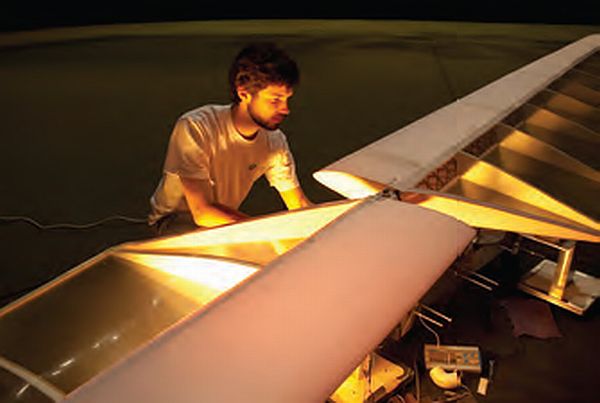
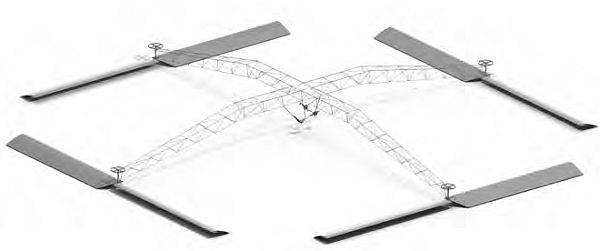
The Gamera helicopter is named after a giant flying turtle featured in a popular series of Japanese films. It is powered entirely by energy that comes from turning pedals with hands and feet. Gamera consists of an X-shaped frame with a rotor at each end. The pilot’s module is suspended in the middle of the frame. Each crossbar of the frame is 60 feet long and each rotor 42 feet across. An essential feature of a human-powered helicopter is that it should be light in weight. Gamera is made from lightweight materials including balsa, foam, Mylar and carbon fibre. It weighs only 210 pounds, including the student pilot.
The team consists of 50 graduate and undergraduate students led by faculty advisors V.T. Nagaraj, Inderjit Chopra and the Dean, Darryll Pines. They have been working for two years to build the human–powered chopper and compete for the Sikorsky prize. The pilot for the tests is Judy Wexler, a graduate student of life sciences at University of Maryland. The Alfred Gessow Rotorcraft Center in the Clark School is one of the top rotorcraft research institutions in the United States.
If Gamera takes off, it not only stands to win the Sikorsky prize but also to establish a world record for the first ever recorded human-powered helicopter flight.

Via: Reuters