
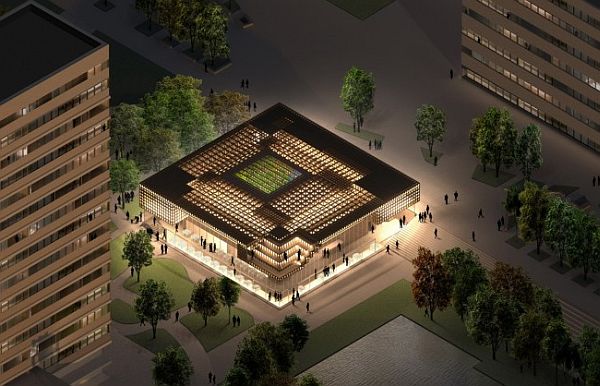
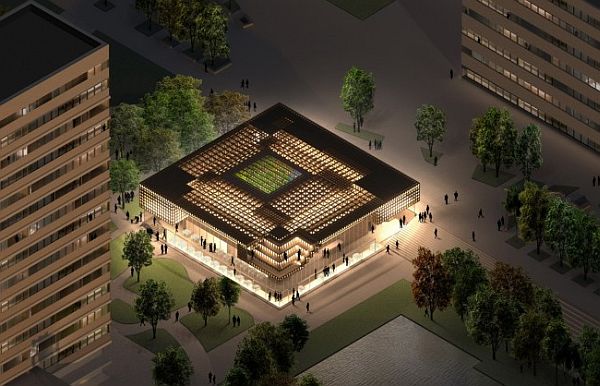
Since the advent of Classical architecture, open pavilions have been used as collective spatial elements for a wide range of functions including acting as markets, gazebos, temple structures and even public squares. Now, taking into consideration this perceptible societal nature of pavilions, NEXT Architects from Amsterdam and MASS Studies from Seoul have undertaken their project of designing a fascinating student pavilion for Erasmus University of Rotterdam.
Dubbed as the Canopy, the architects have envisioned this pavilion as a structural translation of the natural canopies exhibited by the surrounding trees. The horizontality of a leaf canopy embodies the expansive, disseminating yet human scale of the building. The essence of ‘openness’ is quite evident from the abundance of perforations and outlets, bedecking the directional facades on all sides.
From the perspective of location, the structure will occupy a central position on the university campus. Just like an atom whose flexible nucleus pertains to a series of activities, this central location feature will allude to a collective spatial element where students can meet, discuss and even relax. More importantly the focal point will exhibit a unique degree of flexibility, accessibility and enhancement of overall circulation, in relation to its eminent position and open structural attribute.
Coming to the design features, the ruptured roof system will cover a shelter space, which in turn will be used for generation of energy. Moreover, the stratifications imposed by transparent glass facades will maintain a high level of visual connection and natural lighting. But on the other hand, this will also provide a sort of segregation (and regulation) of different climatic zones within the open building. Lastly, the architects have ingeniously planned a partly underground theater, which will double up as a spatial vehicle (buffer zone) for temperature control.
Via: ArchDaily