
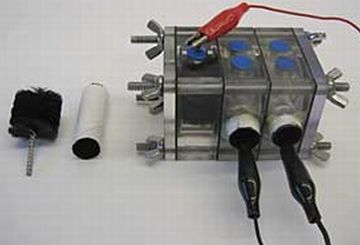
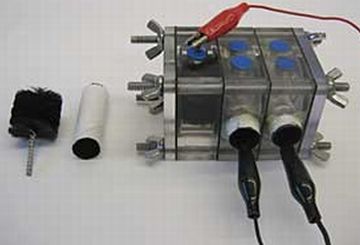
Now, microbial fuel cell gets a new graphite brush anode, the use of which more than doubles the power output of fuel cells compared to the earlier electrode-generations. This new graphite brush anode is developed by the Penn State researchers.
The anode consists of graphite fibers that are wound around a conductive metal core, which is non-corrosive. A new membrane-tube air cathode has been adapted from the existing wastewater treatment equipment to complete the circuit.
In this new method, anaerobic bacteria are placed in the oxygen-free anode chamber of a microbial fuel cell. There they attach to the electrode. Since they are without oxygen, they have to transfer the electrons obtained from consumption — i.e. oxidation — of their food somewhere else and not to oxygen. Thus, they transfer them to the electrode.
The two fuel cell electrodes are at different potentials, hence creating a bio-battery when the system is un-refilled or a fuel cell when refilled. And during this process, the bacteria consume organic matter in the wastewater, cleaning clean it.
The approach, the Penn State uses, makes use of naturally-occurring wastewater bacteria. Thus, they require no special bacterial strains or demand any unusual environmental.
Photo Source: Yi Zuo, Penn State University